jueves, 13 de enero de 2011

“Boleto al Paraiso” to participate at the Sundance Festival


The Cuban film Boleto al Paraíso (A ticket to Paradise), the most recent film by Gerardo Chijona, was selected to participate at the Sundance Festival.


Boleto al Paraiso was one of the 13 films chosen by the selection committee among over 1,000 productions that hoped to be included in the Sundance Festival.


The event, scheduled for January 20-30, 2011, in Park City, Utah, in the United States, was set up by actor and director Robert Redford, and it is considered as one of the most important film festivals internationally.


The Cuban film is Chijona’s fourth movie; it was produced by the Cuban Film Institute (ICAIC) with the participation of Malas Compañias P.C. (Spain), the Foundation Villa del Cine (Venezuela) and the support of the IBERMEDIA Program.


Chijona, director of comedies such as Adorables mentiras (Adorable lies), Un paraiso bajo las estrellas (A paradise under the stars) and Perfecto amor equivocado (Perfect wrong love), explained

that he and photography director, Raul Perez Ureta, wanted the film to be a demi-documentary and to tell the story through images rather than dialogues and dramatic actions.


The film was shot in 52 locations and lasted about six weeks, including 25 night calls and more than a year looking for young actors for the leading characters.

José Martí Memorial Celebrates Its 15

In the historic Revolution Square in Havana, José Martí Memorial will celebrate its 15 anniversary with a commitment to disseminate the various facets of life and work of the Cuban National Hero.

The museologist Isabel Rivero said that the best way to celebrate the event is to continue honoring the intellectual’s outstanding thought, born on January 28, 1853.

"This is an ideal place to convey humanist and revolutionary values to Cuban children and young people, hence its continued efforts to attract new generations," she said.

She also said the memorial has a vital educational role for all levels of teaching, because its materials enrich students’ knowledge about the author of "The Golden Age".

The main event for the 15th anniversary of the memorial will be held on Jan 27 in the afternoon, and guests will enjoy a performance by pianist Frank Fernández.

Before it will be screened the Cuban film "Martí, el ojo del canario" by director Fernando Pérez, and a collective exhibition called Martí and Plastic Arts.

There will be artistic galas for all ages, and others dedicated to political and mass organizations, said the specialist.

domingo, 9 de enero de 2011

283rd Anniversary of University of Havana


Teachers and students marked the 283rd anniversary of the founding of the Royal and Pontifical University of Saint Jerome of Havana, current home of higher education in this city.

During the event, teachers and students highlighted the role of the University of Havana in the country's history; especially the strengthening of the student movement with important leaders such as Julio Antonio Mella and José Antonio Echeverría.

Important professors that have taught in this university include Enrique José Varona, Vicentina Antuña, Mirta Aguirre and Hortensia Pichardo.

The city historian Eusebio Leal said the university traces routes, helps meet the need of man's knowledge and wisdom is sought within it.

So we are proud of this campus, of this hill which is to us as the Athens, as the agora, so we are embraced by the outstretched hands of the Alma Mater, he said. In the ceremony held at the College of San Jerome of Havana, 26 professors of higher education received special recognition for their distinguished work and dedication to students' learning.

viernes, 7 de enero de 2011

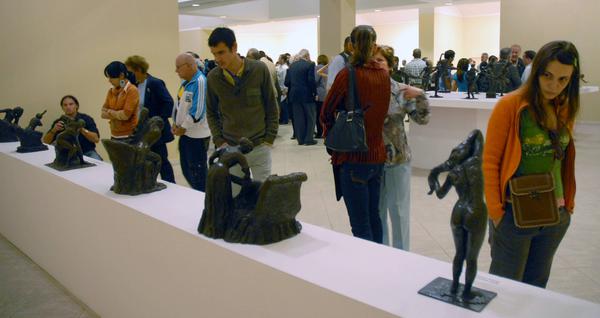
Degas Sculptures in National Museum of Fine Arts


The Cuban National Museum of Fine Arts announced that the exhibit of sculptures by French Edgar Degas (1834-1917) will be open for the public until the end of January.

The exhibit, in the Museum of Universal Arts, in Havana, includes 74 sculptures, the only ones rescued out of the 150 pieces found on his workshop in 1917 after his death.


He only exhibited his works in 1881 to the Parisian society, and due to the violent reaction they received he continued working in reserve.

Havana, Israel, Greece, and Bulgaria are the only four capitals in the world that have had this privilege. American art appraiser Alex Rosenberg made the arrangements for taking the exhibit to Havana on the occasion of the 90 birthday of Prima Ballerina Assoluta Alicia Alonso.


His works reflect famous dancers in movement, the female body in intimacy, horses of different sizes, and big studios dedicated to Matilde Salle.


Paul

Durand-Rouel and Ambroise Bollard, friends of the artist, found a considerable amount of wax, clay, plaster and plasticine sculptures. Some of the pieces were incomplete, broken or twisted.


Later on, in 1919, Adriend-Aurelin Hébrard cast in bronze some of the pieces with the approval of the relatives of the artist.


The first generation bronze sculptures will then be taken to Valencia, Spain

Restoring the Monument in Revolution Square


The monument of Cuban National Hero Jose Marti located in Revolution Square in Havana is undergoing restoration after being erected 50 years ago.

The end of renovation works should be ready by January 27, 2011 to mark the 15th anniversary of the opening of the Jose Marti Memorial inside the monument’s building.

Experts say that it already showed signs of deterioration, including dirty and salt-impregnated walls, and the blocks making up the marble statue starting to come apart.

Restoration works also include roof waterproofing, reprinting of images of Jose Marti making up the memorial’s permanent exhibit and the restoration of interior murals containing excerpts of texts by José Marti.

Works are led by experts with the Jose Marti Museum; maintenance workers from the Palace of the Revolution; and other local construction enterprises and the Havana Historian Office’s restoration company.

The monument’s tower is the highest point in Havana: 112.75 meters high up to the top of the tower and 141.995 meters up to the lights and flags.

Sitting at the tower’s base is a marble statue of Jose Marti made by Cuban sculptor Juan Jose Sicre. The statue is 18 meters high and is surrounded by six pillars representing each of the provinces into which the country was previously divided in with their respective coats of arms.

The monument is located in Revolution Square, home to many of the most important meetings and public events that have taken place in Cuba after 1959.

located in Revolution Square in Havana is undergoing restoration after being erected 50 years ago.

The end of renovation works should be ready by January 27, 2011 to mark the 15th anniversary of the opening of the Jose Marti Memorial inside the monument’s building.

Experts say that it already showed signs of deterioration, including dirty and salt-impregnated walls, and the blocks making up the marble statue starting to come apart.

Restoration works also include roof waterproofing, reprinting of images of Jose Marti making up the memorial’s permanent exhibit and the restoration of interior murals containing excerpts of texts by José Marti.

Works are led by experts with the Jose Marti Museum; maintenance workers from the Palace of the Revolution; and other local construction enterprises and the Havana Historian Office’s restoration company.

The monument’s tower is the highest point in Havana: 112.75 meters high up to the top of the tower and 141.995 meters up to the lights and flags.

Sitting at the tower’s base is a marble statue of Jose Marti made by Cuban sculptor Juan Jose Sicre. The statue is 18 meters high and is surrounded by six pillars representing each of the provinces into which the country was previously divided in with their respective coats of arms.

The monument is located in Revolution Square, home to many of the most important meetings and public events that have taken place in Cuba after 1959.

Our Critic and Essayist Rufo Caballero Dies


The Cuban critic and essayist Rufo Caballero died here of a heart attack. He was 45. He died on Wednesday night, family sources confirmed, and he was cremated. Born in 1966, he left behind an extensive body of writing, profound and sometimes controversial, about film, the visual arts, and music.


Caballero held his doctorate in art and was a senior professor in the University of Havana´s Faculty of Arts and Letters. As a critic of the audiovisual media, he published articles in the print media and appeared on television.


Some of his outstanding books include Un hombre solo y una calle oscura. Los roles de género en el cine negro (A Man Alone and a Dark Street. The Roles of Gender in Film Noir), published by the Cuban Union of Writers and Artists; and Cine latinoamericano: Un pez que huye (Latin American Cinema: A Fleeing Fish), printed by the Autor 2005 Foundation and the Cuban publishing hourse Arte y Literatura in 2007.


Caballero won numerous awards and honors, including the Lya Kostakowsky Hispanic-American Essay prize, the Ibero-American and Caribbean Film Essay prize, and the National Critics´ Prize. In 2003, he received the National Culture Distiction.

Rouen Opera Orchestra to Perform in Old Havana


A piece by Wolfgang Amadeus Mozart will be performed by The Rouen Opera Orchestra, on January 8 in the Minor Basilica of the Convent of St. Francis of Assisi.

The piece, La Gran Partita, Serenade No. 10, KV-361, in B flat, for 12 wind instruments and a double bass, was composed back in 1784 and its premier took place that same year in Vienna.

The orchestra, coming form High Normandy, France, has been involved, from January 3 to 6, in exchanges among professionals, seminars on the restoration of instruments, and courses at the San Felipe Neri Theatre.

There, clarinetist Lester Chio and guests, and the Octet of the Rouen Opera in conjunction with Cuban flautist Niurka Gonzalez will offer a concert on January 7.

They will interpret pieces by Gioachino Rossini, Johann Sebastian Bach and Charles Gounod.

This same theatre will also present a concert by pianist Maria de los Angeles Horta and guests on January 8, at 4 p.m.

We hope it will be a very special performance for our city.